

How do you glue/attach aquarium plants to wood or stone?
Do you have an aquarium with cichlids or other herbivorous fish? Or do you want to make your aquarium more natural by growing some aquarium plants on wood or rock, but you're not sure which ones? In this article, I'll explain which plants you can grow on wood or rock. I've tried everything to determine which plants grow successfully and which don't.
You can clamp aquarium plants between wood, tie them with rope, or glue them down with cyanoacrylate-based superglue, aquarium plant glue, or aquarium-safe silicone sealant. Once they're secured, it's just a matter of waiting for the roots to take hold.
Which stones and wood can you use to support aquarium plants?
Any piece of wood or stone can be used to grow aquarium plants. However, there are certain types of wood and stone that are often used because plants grow well on them. When choosing the aquarium wood or stone you want to grow an aquarium plant on, make sure you already have a good idea of how, what, and where you want to attach it.
Make sure it is a stiff spot on the wood or rock so that the plant roots can attach well.
Some well-known types of wood and stone used to grow plants are:
- Lava rock
- Dragonstone
- Broken stone
- slate stone
- Mini landscape stone
- Talawa wood
- Root wood
- Bogwood
- Mopani wood
How do you attach aquarium plants to wood or stone?
You can attach aquarium plants to wood or stone by gluing, tying, or clamping them. You can attach aquarium plants or moss with safe cyanoacrylate-based superglue. You can also use aquarium-safe sealants such as Polymax from Bison or Conexo from Juwel.
Another method is to wedge the aquarium plants between the rocks or aquarium wood. You can do this by finding a gap in the wood or rock and simply wedge the plant in until it stays in place.

This is a method I often use because it doesn't require any glue or other means. I'm also not very handy with small pieces of string to tie the plant down.
That is why I often choose this method because the plant grows naturally and by itself.
The final option is to use special aquarium plant glue. Personally, I find this an expensive option because aquarium plant glue is quite expensive compared to a tube of sealant.
You can glue many more aquarium plants with a tube of sealant or Conexo than with a small tube of aquarium plant glue. This is my personal preference, and feel free to experiment to find what works best for you.
How do you attach an aquarium plant to wood or stone?
Okay, now that you know everything you need to know about attaching aquarium plants to wood or stone, it's time to actually get started with securing them.
In this example I use the 3 known methods, a piece aquarium mopani wooden and an Anubias Nana.
Method 1: Clamp the aquarium plant to a piece of wood
With this first method, I don't use aquarium glue or sealant, but rather the actual piece of mopani wood. The wood has grown in such a way that I see a perfect spot to attach an Anubias nana.
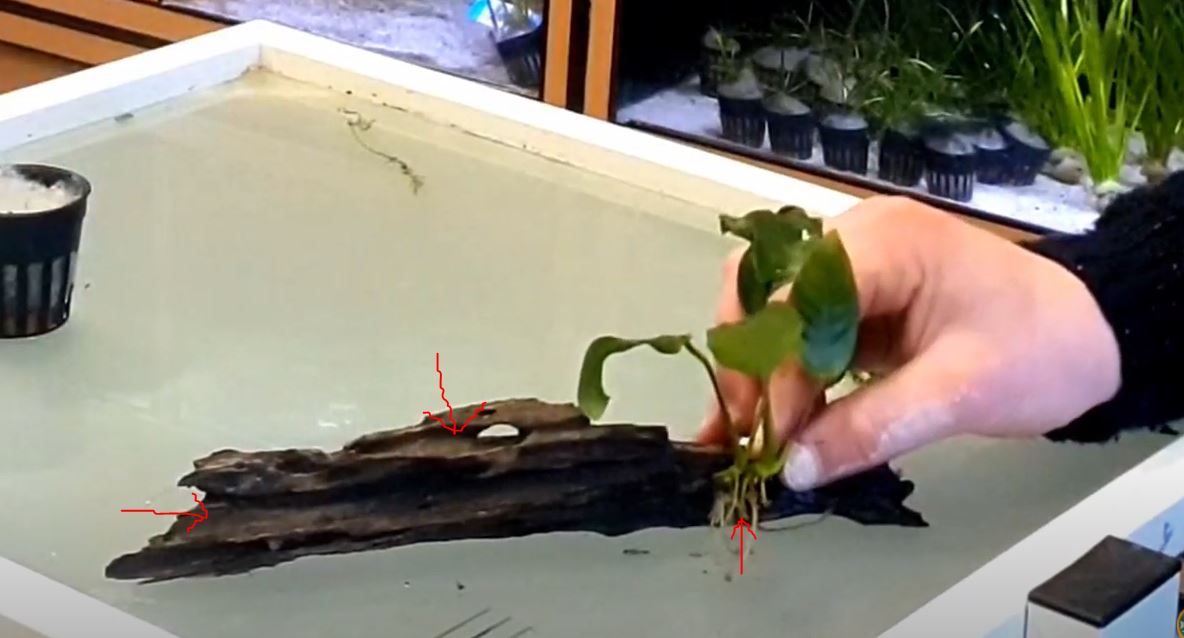
Next, it's time to remove the Anubias Nana from its pot and locate the base of the rhizome. It's important to only secure the base of the rhizome and not halfway down, otherwise the rhizome will eventually become pinched and broken.
I simply wedge the back of the Anubias into the corner of the mopani wood. I keep pushing it until the rhizome plant is firmly attached. I check it one last time, and voila, an aquarium plant on wood!
Method 2: Gluing the aquarium plant to a piece of wood
In this second method, I use cyanoacrylate-based liquid superglue. Make sure the piece of wood or stone is completely dry. With wood, I also always rub the bark with a rough cloth so the glue doesn't stick only to the outer layer of fabric.
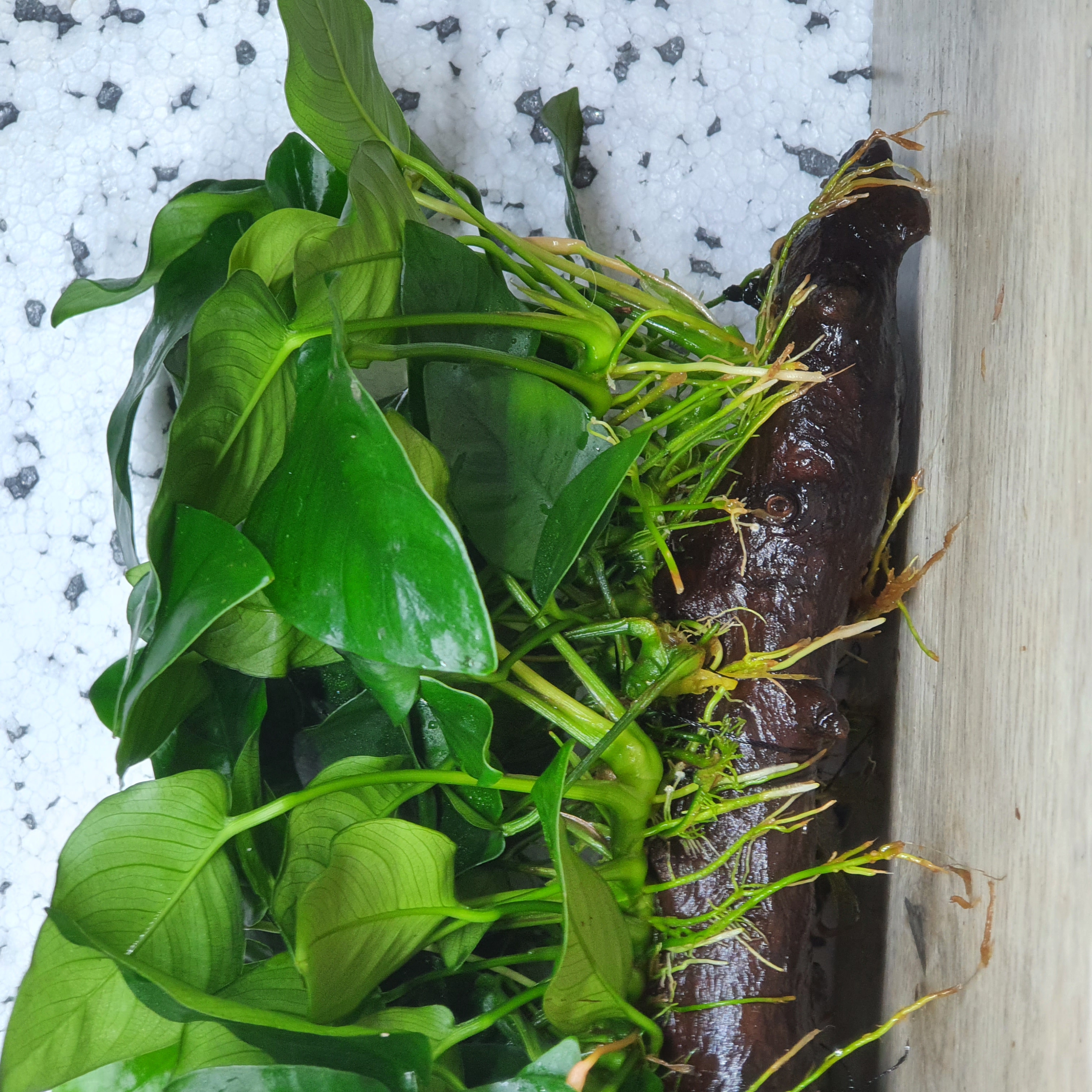
I choose a random spot on the wood and apply a drop of liquid glue. Then, using pliers, I grab the Anubias Nana and press it onto the glued spot. I wait a few seconds for the superglue to dry and the Anubias Nana to adhere.
Method 3: Tying up the aquarium plant.
You can also choose to tie aquarium plants with a piece of cotton string. I'm not a fan of this myself, as I'm not very adept at tying knots with thin thread. (To each their own, I guess.) This method is especially popular with aquarium mosses because you can tie it like a ribbon over the wood or rock. I'm currently using the Anubias Nana from the previous methods.
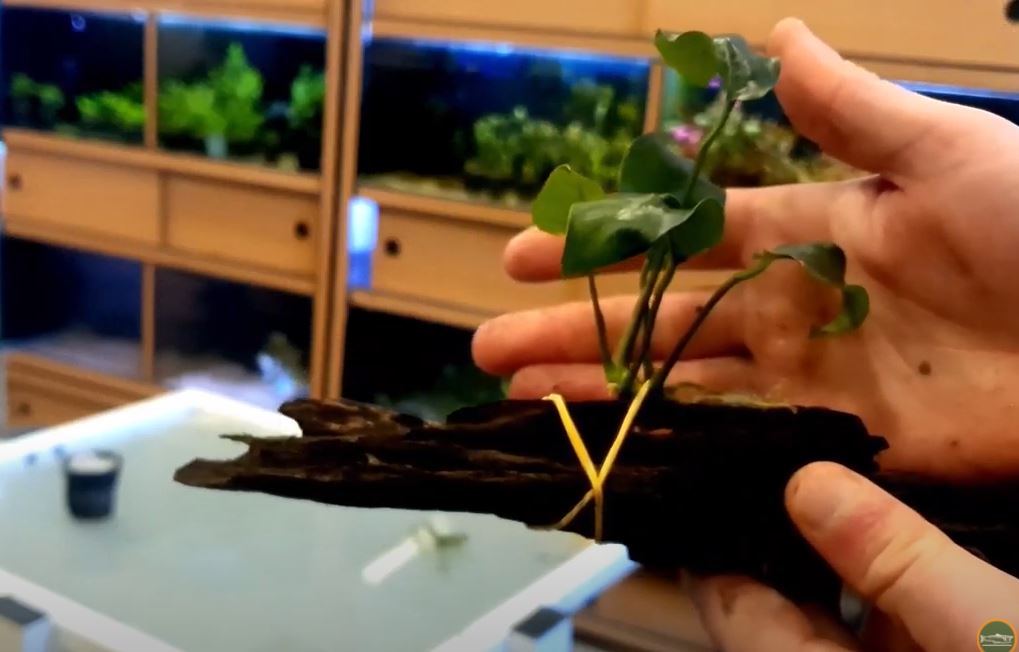
It's important not to tie the string too tightly around the aquarium plant, as this will pinch the plant and cause it to die. If you use cotton string, you don't need to remove it. This string dissolves naturally once the plant has taken hold.
Save time and go for ready-made
If, after reading this article, you're put off by the work involved in attaching an aquarium plant, or if you want to be done quickly, you have one last option: buy a ready-made piece where an aquarium plant has grown.
We sell the pieces for around €20, and you can choose from three sizes. We deliberately chose three sizes because we saw that no different sizes were offered online, even though the aquariums do vary in size.
Thank you so much for reading this long article! It took me 3.5 hours to write. I'd love to hear your thoughts in the comments below or by sharing this article. Thanks!


